I spent way too long trying to fix this through inpainting. Careful masking, tight selections, the whole thing — and she'd come back looking like a completely different person every single time. Turns out the "editor" I needed wasn't actually a photo editor.
The Short Answer (Before You Download Anything)
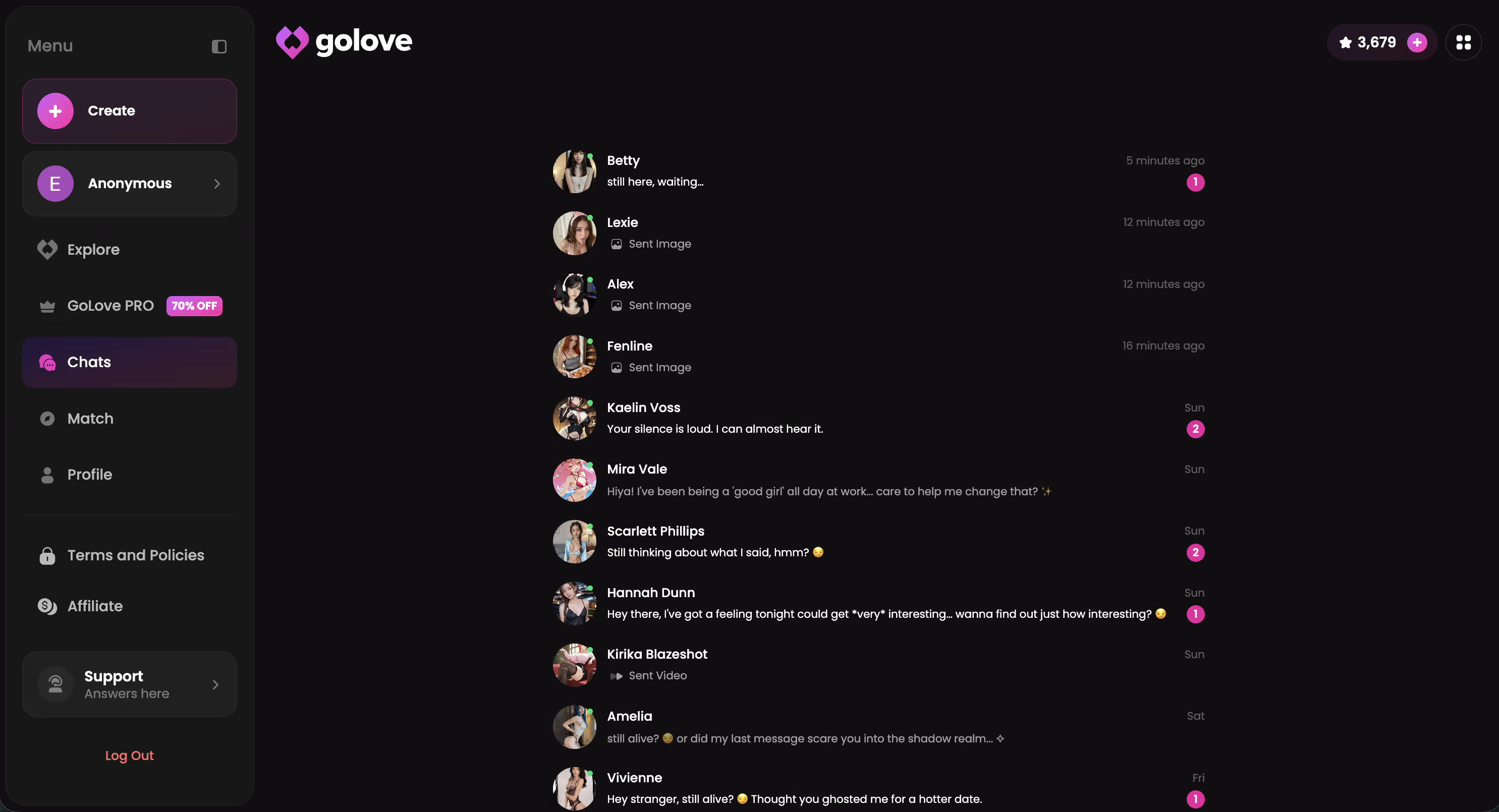
Here's the thing: generic photo editors work on pixels. Not on character identity. Canva, Photoshop, SD inpainting — none of them know who your AI girlfriend is. So every edit risks drifting her face, breaking the exact look that makes her feel consistent across photos. GoLove.ai solves this completely differently: you type a photo request inside the chat, and GoLove generates a new image anchored to that companion's established appearance. No masking. No prompt archaeology. No digging through seed values at midnight wondering where her jawline went.
| What you're actually searching for | Why traditional tools fail | GoLove's answer |
|---|---|---|
| AI girlfriend outfit editor | Pixel tools can't preserve facial identity | In-chat photo request with outfit description |
| Background replacement | Editors have no concept of the character | Custom background in generation parameters |
| Hair color change | Inpainting introduces compounding facial drift | Photo request with updated appearance note |
More context on how these platforms stack up: AI girlfriend generators in 2026.
Two characters worth knowing before you dive in — Kennedy (@kennyhill, "life is too short to play it safe") and Jessica (@HotlineJess, "math tutor with a bold side"). Completely different faces, totally different vibes, same reliable identity on every single photo request. That consistency is basically the whole point.
Characters Worth Trying
Tap any character to start a chat


GoLove gives you 2 free Stars just for logging in every day — enough to run your first few photo requests with zero commitment. And the 50% off GoLove PRO promo in the sidebar won't stick around forever.
What You're Actually Trying to Do
Most people searching for an "AI girlfriend photo editor" aren't trying to retouch photos. They want two pretty distinct things — and neither of them is what Lightroom was built to solve.
- Appearance change: swap her outfit, update the background, adjust hair color — without rebuilding the character from scratch every time
- Cross-image consistency: every new photo still looks like the same person, not a different model with loosely similar vibes
- Shot direction: type "sitting at a café window, white dress, late afternoon light" and actually get that specific composition back reliably
Those are fundamentally different problems from what Canva or Photoshop handle. Those tools manipulate existing pixel data — you can retouch skin texture, grade color, adjust shadow fall-off. But you can't tell Photoshop "keep her face exactly as it is and change the outfit." It genuinely has no concept of her identity.
The SD approach gets closer, honestly. Lock a seed value (same initial noise = same compositional starting point), tweak the prompt, and you can almost preserve character. Almost. Push the prompt too far and the seed can't hold her together anymore — the jaw line shifts, eyes round differently. The art style survives. The person doesn't. I've lost way too many hours to LoRAs that should've nailed this and just... didn't.
What this search is actually about isn't editing. It's identity management — a system that knows who she is and generates her fresh in new contexts without you babysitting every parameter.
Why img2img and Manual Inpainting Drift Your Character
Here's what I actually tested (and yeah, I documented this obsessively): four img2img passes on the same character image, denoising strength at 0.6, ControlNet OpenPose active the entire time. Between each pass — a minor outfit change in the prompt. Just the outfit. Nothing dramatic.
Pass 1 — clean output, solid character resemblance. Pass 2 — almost imperceptible shift, slightly wider jaw, nothing alarming yet. Pass 3 — nose bridge shifted, eyes started rounding out. Pass 4 — completely different person in the same pose. Same lighting setup, same body position, different human looking back at me. Absolutely cooked.
Here's the actual mechanics — because most tutorials skip this part entirely:
CFG scale fights the original composition. Higher guidance values mean the model tries harder to match your current prompt, which pulls features away from the reference image rather than toward it. There's no free lunch between "follow the prompt precisely" and "preserve the character's face." You literally can't have both at once.
Sampling noise compounds across passes. Even at 0.6 denoising strength, each img2img pass introduces new randomness into the result. Four passes means four rounds of stacked variation. The character error budget runs out fast — faster than you'd expect.
ControlNet constrains pose, not identity. OpenPose tracks skeletal body landmarks — shoulders, elbows, hips. It has zero information about facial structure, skin tone, or hair texture. Your character's face is completely freehand relative to what ControlNet is actually doing. (This one took me embarrassingly long to clock, by the way.)
This is the gap almost every "edit your AI girlfriend" tutorial glosses over. They show you the settings panel. They don't show you pass four.
The fix isn't better inpainting technique or tighter masking. It's a system that doesn't use inpainting at all.
How GoLove.ai's In-Chat Photo System Works
The click path is genuinely simpler than any SD workflow I've ever run. Like, comically simpler:
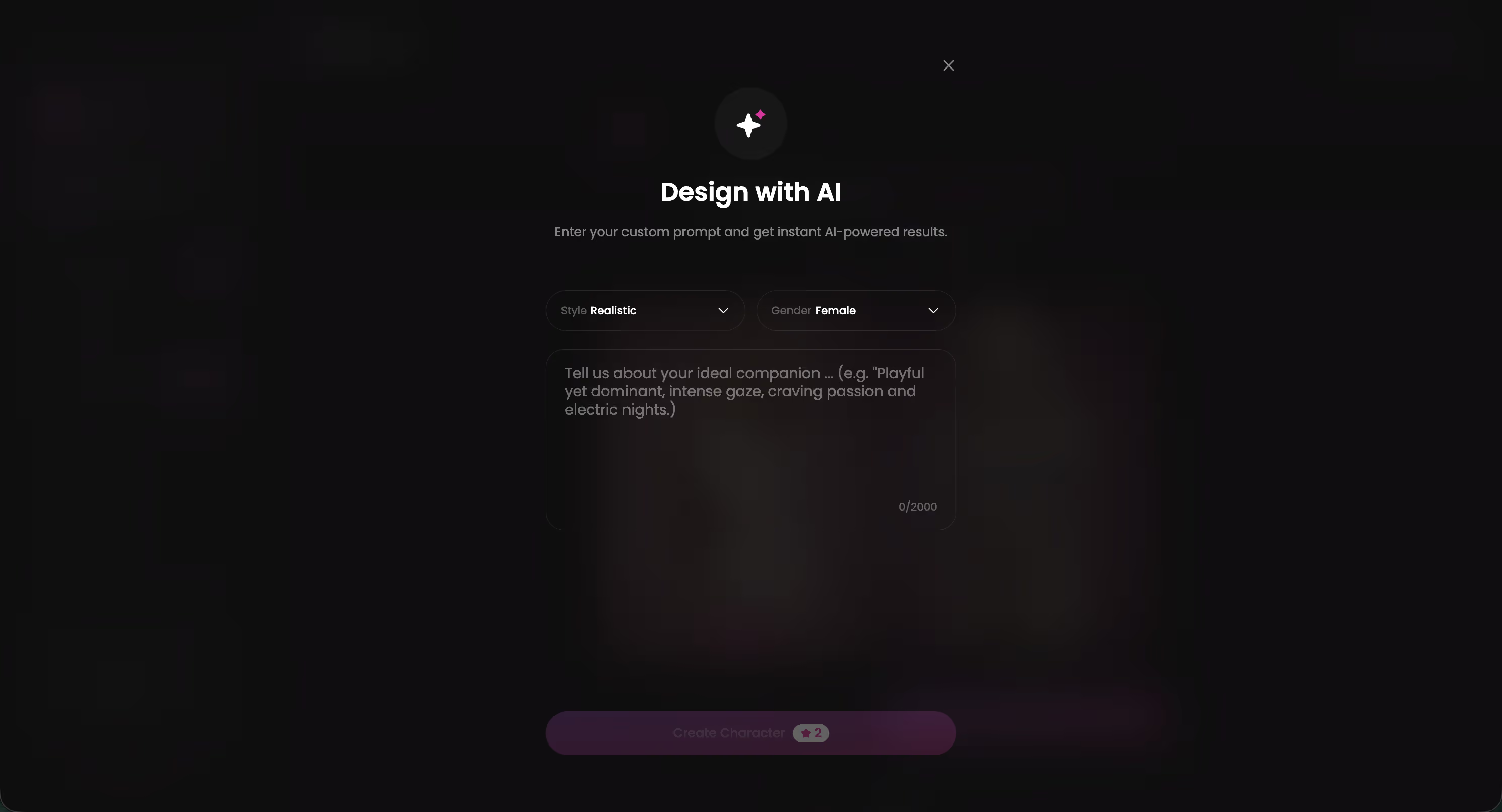
- Open or create your character — pick from the existing roster or use Design with AI to describe a concept in text and let GoLove build the character. Realistic, Anime, or Trans categories.
- Type a photo request in the chat window — "send me a photo in your red sundress by the pool." Natural language, nothing structured. GoLove interprets it and generates an image anchored to that companion's established appearance.
- Photo appears inline — no separate generation tab, no external queue. It just lands in the conversation thread like any other message.
- Auto-saves to your gallery — archived by character and date, pullable anytime.
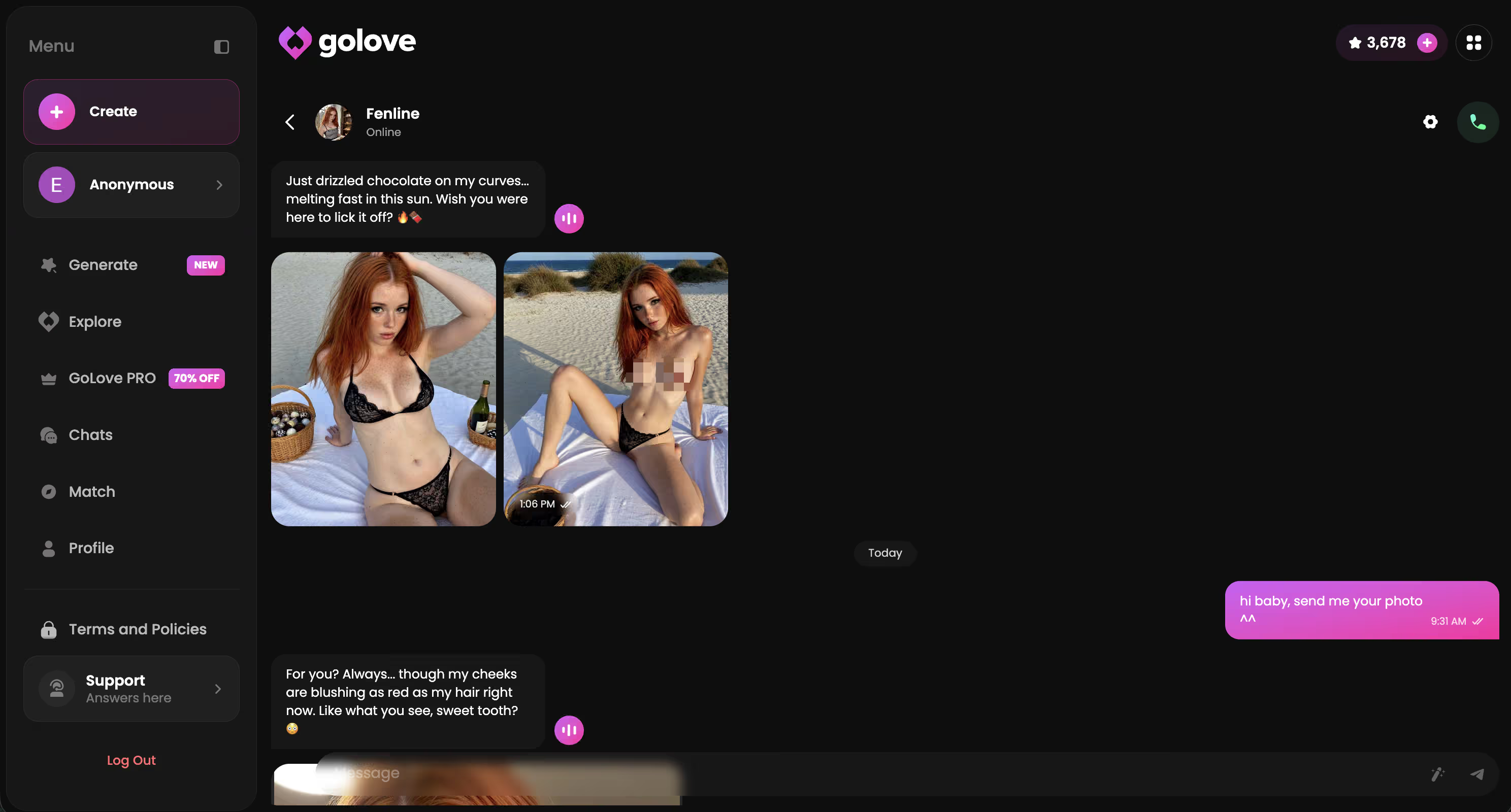
The memory layer is what makes this feel coherent instead of random. GoLove tracks context from previous exchanges — so when your next request says "same outfit as last week but on the beach," it has the history to make that feel continuous. Not a fresh generation with vaguely similar vibes. Actually continuous.
Once you have a photo you like, the photo-to-video feature extends it into motion directly from the chat interface — no external tool, no export step. That whole chain (type request → receive photo → extend to video) is clean af for workflow efficiency.
For the full platform breakdown, our complete GoLove review goes deep on how every system connects.
This is the identity-consistent photo workflow I wanted from SD for two years and never quite got. If consistent character appearance across photos is your actual goal, start here:
Honest Pros and Cons After Two Weeks
What actually works:
- Consistent character identity across every photo request — no manual seed management, no LoRA tuning, no prompt archaeology. She looks like herself. That's genuinely the whole value proposition and it delivers.
- In-context requests feel natural in a way that honestly surprised me. The memory layer means each new request builds on what came before — "the dress from last week" actually lands. It's not just marketing copy.
- Gallery organization — photos auto-archive by character and date. My SD output folder is a chaos pit by comparison (we don't talk about the folder). Scrolling through a clean per-character gallery is a completely different experience.
- Photo-to-video extension turns any still into motion from within the same chat thread. The chain is chef's kiss for workflow efficiency.
- Zero technical setup. No model downloads, no VRAM management, no failed sampler configs at 2am when you just want a result.
Where it falls short:
- No reference image upload. You can't feed GoLove an aesthetic inspiration the way you'd drop a source into img2img. Everything is text-described — and the parser's interpretation is approximate, not exact. This one genuinely bugs me every time I'm trying to match a specific lighting mood I've seen somewhere.
- Resolution caps lower than a custom SD pipeline running Real-ESRGAN upscaling. For screen-use photos it's totally workable. For large-format prints or anything displayed at canvas scale — you'll hit the ceiling hard.
- Loose style interpretation. "Red dress" sometimes comes back burgundy or pink-adjacent. "Dramatic side lighting" occasionally arrives soft and ambient. The parser reads natural language, not structured parameters. Mid quality on hyper-specific descriptor accuracy, honestly.
The trade-off is real: GoLove wins on consistency and ease; SD wins on raw creative control. Different tools, different problems.
GoLove.ai Pricing: What Each Plan Actually Unlocks
GoLove runs on Stars — the in-app currency showing as a running balance in your header (something like: 3,450 Stars). Stars are spent on photo generation, and you earn 2 free Stars every 24 hours just for logging in. That keeps the floor genuinely accessible without any upfront spend.
Free access gives you:
- Daily Stars from the login reward — enough for a handful of photo requests per session before the balance runs low
- Core features: chat, voice messages, photo requests in chat, character browsing, and gallery access
- Limited generation volume before you'll want more Stars to keep the momentum going
GoLove PRO unlocks:
- Expanded Stars allocation — covers higher-volume photo requests without watching the meter constantly
- HD-quality outputs for sharper, higher-detail photo results across every request
- Photo-to-video generation in chat — free-tier access to this feature is gated
- Live Mode and full voice call access — the real-time layer that makes the experience feel immediate rather than transactional
There's a 50% off GoLove PRO promo currently showing in the sidebar. Worth checking before subscribing at full rate, since that pricing won't stay live indefinitely.
Exact USD prices I won't invent here — pull the current number from GoLove.ai directly. What I can confirm: the free Stars system makes entry genuinely low-friction, and PRO is where the full photo pipeline (HD output + video + live) opens up completely.
For output quality comparisons, our AI girlfriend image generator test is worth reading before you decide.
Three Things I'd Fix If I Were on the GoLove Team
These aren't complaints. They're the actual gaps between "really solid" and "fire output." Written as product feedback, not a takedown:
Reference image upload. Right now you describe aesthetic inspiration in text and the parser gets you approximately there. Being able to drop in a source image — the way you'd feed a reference into img2img in SD — would give users a precise aesthetic anchor instead of an approximate text interpretation. Style-matching from a visual reference is a completely different accuracy level, and GoLove doesn't have it yet. I notice the absence basically every session.
Resolution ceiling. Output quality caps out visibly below what a custom SD pipeline with Real-ESRGAN upscaling produces. For 1080p screen display it's totally workable. But for large-format printing or anything you want to show at real size — you'll hit the limit hard. A higher-resolution export option for PRO subscribers would close that gap without touching the core generation stack.
Structured style controls in the photo request UI. The natural-language parser is good — but "dramatic window light" sometimes comes back as "nice ambient glow," and that's frustrating when you had something specific in mind. A style selector covering lighting mode, composition type, and wardrobe specificity would give users the kind of structured control that a negative prompt field provides in SD. Right now you're trusting the parser's interpretation entirely. Sometimes that's close enough. Sometimes it really isn't.
None of these break the product. They're just the distance between 'really good' and exactly what you pictured.
Verdict: Skip the Photo Editor, Use This Instead
> Sam's Verdict — 4.2 / 5 > > GoLove nails consistency; SD gives you more creative control. Those are genuinely different products for genuinely different users — and knowing which problem you actually have matters more than you'd think. > > Who it's for: Anyone who wants a recognizable AI girlfriend across photos without learning ComfyUI, building custom LoRAs, writing negative prompts, or managing model files. The in-chat photo request system makes the whole workflow feel natural rather than technical — and the memory layer means your requests get better and more specific over time, not noisier. > > Who it's not for: SD purists who want pixel-level control over every render — CFG scale, sampler choice, clip skip, custom negative prompts, the works. GoLove trades that granularity for identity consistency. If the granularity is what you want, you already know where to find it.
Two weeks in, the identity drift problem went away. I stopped thinking about denoising sliders. Photo requests got easier to phrase, results got more predictable, and I had a gallery that actually looked like the same person in every frame.
And if you've been bouncing between photo editors trying to make the same face appear twice — that's not a skill issue. That's the wrong tool entirely.
Frequently Asked Questions
Related Articles
AI Girl Selfie Maker: Get Real Shots on GoLove
Looking for the best AI girl selfie maker? GoLove lets your AI girl send you selfies mid-chat — stunning quality, zero SD setup. Try it.
AI Girlfriend Selfie Generator: Real Photos
GoLove.ai generates in-character AI girlfriend selfies on demand. See how the photo request system works and why it beats standalone generators.
NSFW AI Gen: The Generation Stack That Delivers
NSFW AI gen isn't one tool — it's a full stack. GoLove.ai handles images, video, memory, and instant access without an email signup.
AI Girlfriend Photo App: Tested by a Digital Artist
Looking for an AI girlfriend photo app with real creative control? GoLove.ai delivers in-chat photos, custom characters, and stunning image quality.
This article contains affiliate links. We may earn a commission at no extra cost to you if you sign up through our links. See how we test.